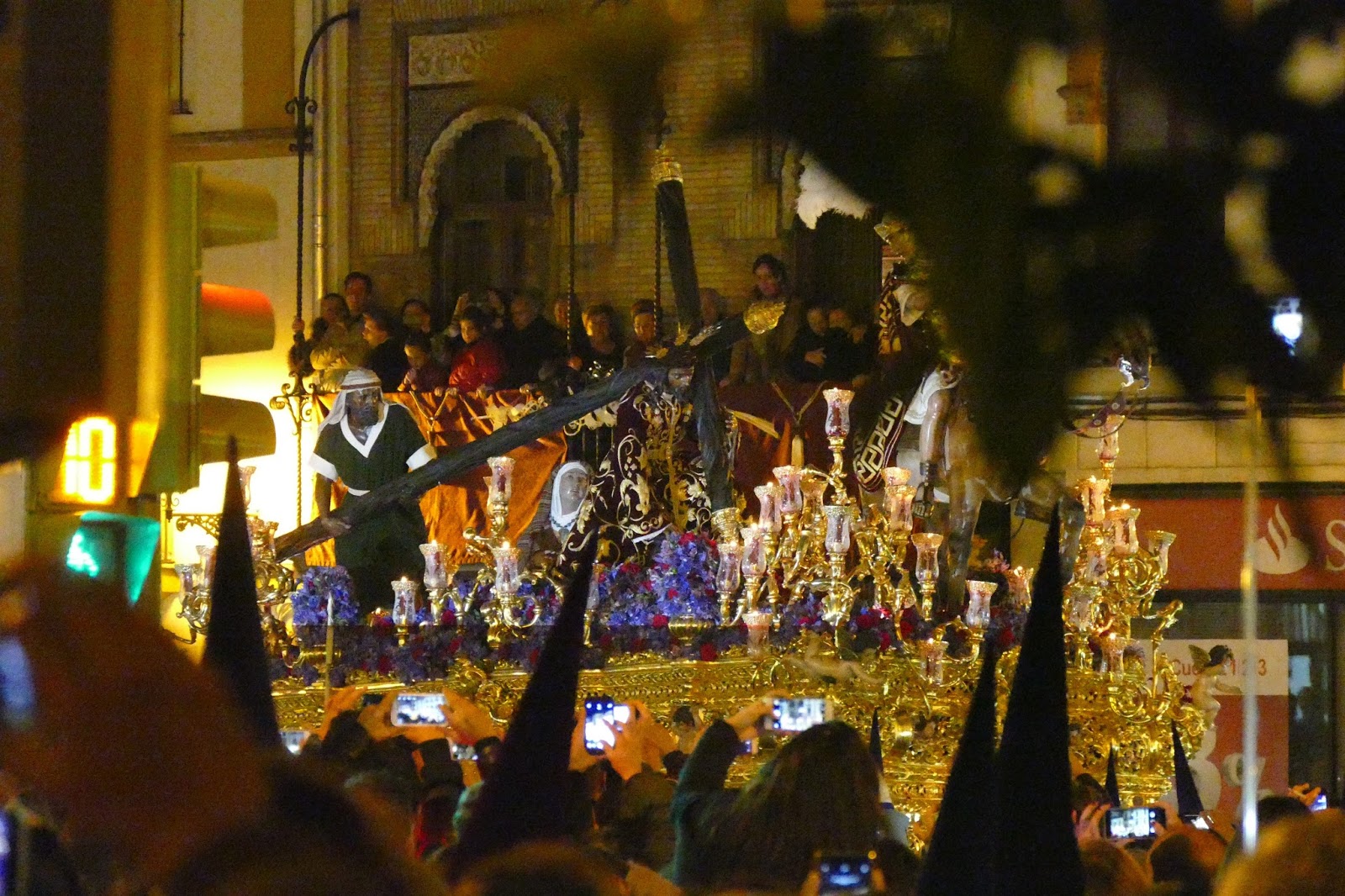
Semana Santa (Holy Week) is the defining cultural root of Sevilla. Each day, from Palm Sunday through Easter, more than 60
cofradías or
hermandades (brotherhoods) that support individual chapels or churches, parade their life-like statues of the Passion of Christ and the grieving Mary, carried on ornate wooden floats (
pasos), from their home chapel, through the city, through the Cathedral (Catedral de Sevilla, with la Giralda) and back, a round trip that takes up to 12 hours. About a million visitors come to Sevilla for Semana Santa. Among residents, it seems to be a split between those who anchor their years around Semana Santa, and those who find it amazing ("oh, you definitely must see it") but who have reached their lifetime quota ("but we are going to the beach for the week to escape all the
bulla"). Schools are out all week, everything (except restaurants) is closed Thursday and Friday, and the city is transformed. We spent Sunday and Monday in Sevilla, then went to Portugal for Tuesday-Thursday, then returned to joined in the
Semana Santa activities again beginning Thursday night -- or Friday morning -- at 2:00 a.m.


A
hermandad might have several thousand
cofrades (members, both men and now women in most
hermandades) who parade the statues. First comes the
Cruz de Guía (Guiding Cross) and the
estandarte (insignia flag), then most of the
cofrades dressed as
nazarenos with tall pointed hoods (
capirotes), walking two-by-two, often barefoot. The
capirote is reminiscent of, but of distinct origin from, KKK hats. The colors differ among the
hermandades. The origin is more of a dunce cap, symbolizing humility of the
cofrades. In a
hermandad with 2000 members, there might easily be more than a thousand
nazarenos in this first group; they are subdivided further, each subgroup with its own standard. The
nazarenos are followed by acolytes (
acólitos), boys wearing church vestments and carrying candles and crosses and ornate staffs and incense.

Then comes the
banda de musica (marching band), playing slow, usually minor-key marches, often with impressive cornet descants. The bands come in two types; a drum-and-bugle corps style band with an assortment of brass and percussion, or a marching wind orchestra that includes flutes, clarinets, saxophones, oboes, and bassoons, in addition to the brass and percussion. These are highly professional bands, hired by the
cofradías, not just a collection of people from the
hermandad who play instruments.
 |
| Cristo leaving La Estrella on San Jacinto, Triana |
 |
| Paso del Cristo La Estrella |
The band precedes (sometimes follows) the first
paso, which carries the Cristo, in a scene from the last days of his life. Sometimes Christ is already on the cross, or is praying, or is carrying the cross accompanied by a Roman soldier. The
paso is gilded in gold. It is carried from below by a hidden team of
costaleros, brawny men who wear a special headdress and support the
paso on their shoulders and heads. The
capatáz walks in front of the
paso and gives orders, often with thumps of a cane, to the
costaleros to raise, lower, or turn the
paso. The
costaleros take turns frequently, since the
pasos generally weigh more than a ton.
 |
| Paso del Cristo de la Esperanza de Triana |
Seeing these
pasos as an outsider provokes a mix of feelings. Many of the gessoed and polychromed wooden sculptures date back to the 16th and 17th centuries and are spectacular works of art. The designs of the
pasos are baroque without compare. They are, if nothing, spectacular. At the same time, the
pasos are covered in gold (or silver, in the case of the
pasos de María), that was pillaged from the Americas at the expense of so many indigenous people, then shipped straight to
Sevilla, the "
puerto y puerta de Indias".
 |
| María Santísima from La Estrella |
Then then whole thing repeats: more
nazarenos, more
acólitos, another
banda, and then the
paso de María Santísima. The
paso de María, with the Virgin in mourning with tears on her cheeks, is gilded in silver and with a canopy and mountains of candles. And some more
nazarenos.
 |
| Crowd watching María de La Estrella en Plaza Altozano |
 |
| Paso de María leaving the chapel La Estrella on San Jacinto in Triana |

On most days the processions start in the afternoon, visit the Cathedral, and return home at 2 or 3 in the morning. Thousands of people line the way, especially at key corners with good views as the
costaleros turn the
paso, and there are a number of areas along the main path near the cathedral where people from the right families can rent chairs with special views of the processions. Everyone is dressed up, from kids to grandparents. The solemnity is very palpable.
 |
| Crown at the Madrugá procession from La Esperanza |
On the night of Holy Thursday - Good Friday, the timing of the processions changes to the
Madrugá (from
madrugada, dawn), starting at 2-3 a.m., and returning in the early afternoon. We took an evening nap after returning from Portugal, and then got up to watch
La Esperanza de Triana pass through the Plaza de Altozano (just around the corner from our house), from 2:15-4:00 a.m. The crowd was at least as big as during the day, and the candles really made everything spectacular. When the Christ passes, all was silent, and if any of the
many thousands of onlookers spoke too loudly there was a collective "shush" that brought the whole
crowd back to silence. When
María passed, however, there were calls-and-responses extolling the virtues of María and neighborhood "¡
Viva María, Madre de Dios! ¡
Viva Triana!"
We stood to watch next to the ruins of
La Castilla de San Jorge, which was the seat of the Spanish Inquisition at the time most of the Semana Santa pageantry was developing. We saw them return the next afternoon from our balcony as they processed down Pagés del Corro.
 |
| Paso del Cristo de La Esperanza de Triana |
 |
| María de La Esperanza de Triana |
 |
| View from our balcony of María de La Esperanza returning on Pagés del Corro after the Madrugá |
The "performance" of Semana Santa is impressively well orchestrated, with a pre-printed guide that gives the time that each procession will be at each key intersection for the whole week, and a million people peacefully moving throughout the city, day and night, for a week. But to call it a "performance" isn't quite right, because this is so much a part of the Sevilla culture. I happen to be reading an historical novel by Francisco Robles called El Aguador de Sevilla, which is about the painter Diego Velázquez and the imaginario (sculptor) Juan Martínez Montañés, both from Sevilla. Montañés and the teacher of Velázquez (Francisco Pacheco) made some of the Cristos and Marías that are on the pasos in the 17th century. A character in the book, a cynical 21st century British art historian, watching one of the Semana Santa processions, confided to his friend "I am feeling something I have never experienced before, something that can only be when what happens is true, and not theater...". And so it is in Sevilla. I often saw people with tear-streaked faces as the Christ or María
emerged from the chapel or passed by. People on smartphones in the
crowd were sending and receiving photos and commentary among family and friends who
were at other, simultaneous processions, so that everyone could
experience as much of Semana Santa as possible, and stay in close contact with loved ones. This is real, and has been real for almost 500 years; an experience shared deeply across generations.


 A hermandad might have several thousand cofrades (members, both men and now women in most hermandades) who parade the statues. First comes the Cruz de Guía (Guiding Cross) and the estandarte (insignia flag), then most of the cofrades dressed as nazarenos with tall pointed hoods (capirotes), walking two-by-two, often barefoot. The capirote is reminiscent of, but of distinct origin from, KKK hats. The colors differ among the hermandades. The origin is more of a dunce cap, symbolizing humility of the cofrades. In a hermandad with 2000 members, there might easily be more than a thousand nazarenos in this first group; they are subdivided further, each subgroup with its own standard. The nazarenos are followed by acolytes (acólitos), boys wearing church vestments and carrying candles and crosses and ornate staffs and incense.
  Then comes the banda de musica (marching band), playing slow, usually minor-key marches, often with impressive cornet descants. The bands come in two types; a drum-and-bugle corps style band with an assortment of brass and percussion, or a marching wind orchestra that includes flutes, clarinets, saxophones, oboes, and bassoons, in addition to the brass and percussion. These are highly professional bands, hired by the cofradías, not just a collection of people from the hermandad who play instruments.


 On most days the processions start in the afternoon, visit the Cathedral, and return home at 2 or 3 in the morning. Thousands of people line the way, especially at key corners with good views as the costaleros turn the paso, and there are a number of areas along the main path near the cathedral where people from the right families can rent chairs with special views of the processions. Everyone is dressed up, from kids to grandparents. The solemnity is very palpable.