Sunday, November 8, 2015

Tourists at home

We spent this weekend (besides cleaning the flat) being tourists in Sevilla. 
Friday night, while Elias wandered Sevilla quedando with his school class, Ingrid and I had a great date for tapas at the old Las Golondrinas (we've gone to the new one next door a couple times, but this was our first time in the original).  Same great food, older (and beautiful and busy) atmosphere.

Saturday afternoon we walked up the river to the Centro Andaluz de Arte Contemporaneo, which was a remodeled monestery (Cartujo), remodeled military site, remodeled pottery factory, and finally, remodeled as an art museum in the 1990s.  The building itself is wonderful, including the chimneys remaining from the days as a pottery factory.   We bike/skate past it every time we go to the EBD, but hadn't taken the time to do more than peak in before.

The displays were really interesting, mostly based around videos.  Some work focused on 1950s French short films by Alain Resnais were great, including one of the National Library in Paris and another on Picasso's Guernica.  Elias was really taken by films from the Occupy movement in various countries by Oliver Ressler, showing footage inside political street protests.  This sparked a great discussion on the way home about protest, civil disobedience, personal responsibility for disobedience, and the difficulties in intervention by powerful countries in problems of smaller countries.  Art at its best to get you thinking. 


Ingrid, Eli, and Christopher C.
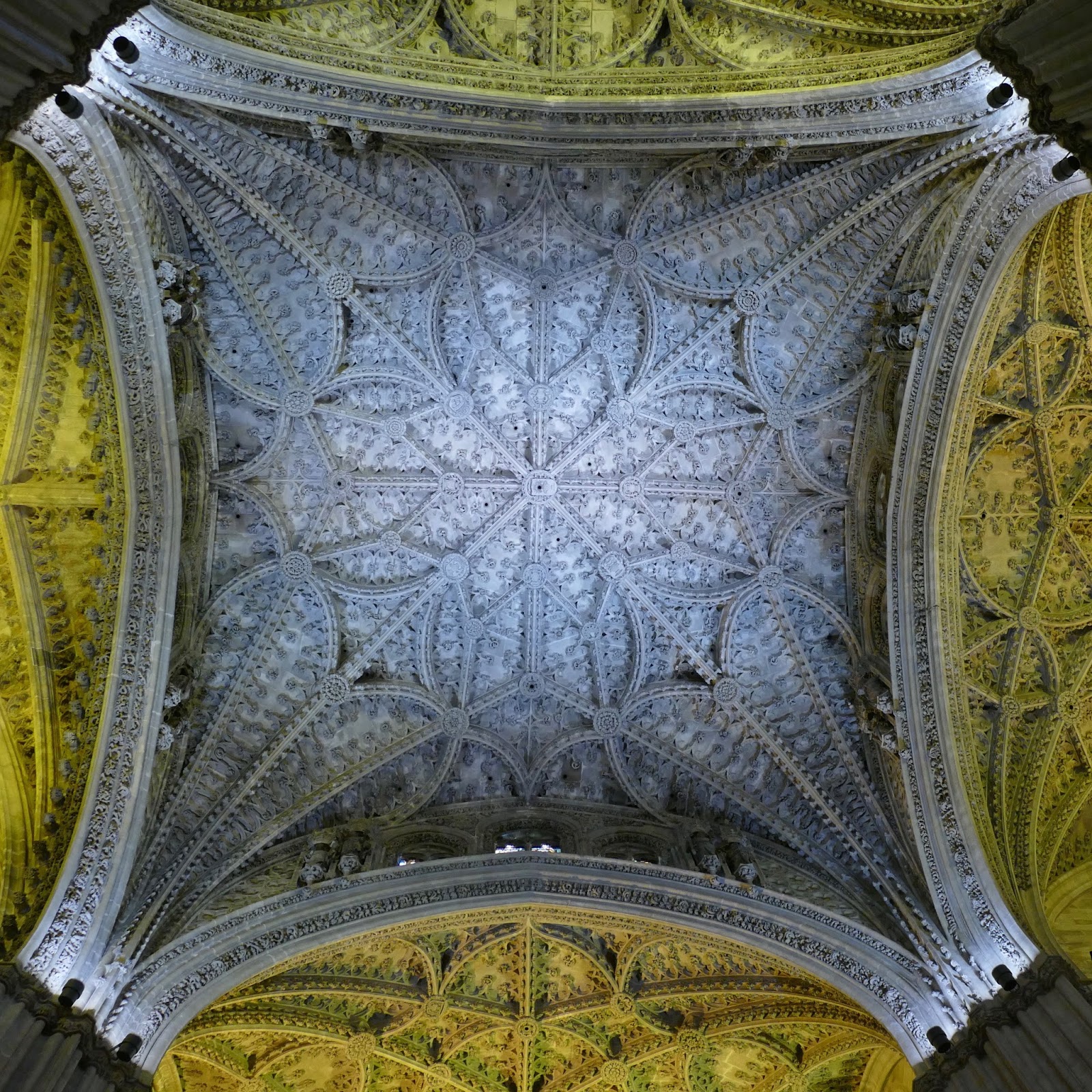
Sunday we ¡finally! went to the Catedral de Sevilla and the Giralda, the towering symbol of Sevilla.  The Cathedral dates to the 14th century, claim to the be 3rd largest in the world, and houses tremendous art and, among many others, the mausoleum of Christopher Columbus (Cristóbal Colón). 


The gothic ornamentation everywhere was over the top. 

Besides lots of Virgins, gory Jesuses, and even the severed head of John the Baptist, there was some quite impressive art. 


The view from the top of the Giralda (originally a minaret before the fall of Sevilla to the Christians), across all of Sevilla was spectacular.  We picked an unusually warm and sunny day for the season and were well rewarded with the views.


Monday, November 2, 2015

Gibraltar

We took advantage of the long weekend for Día de Todos los Santos to explore more of Andalucía, this time to the southernmost part of Spain by Algeciras and the United Kingdom enclave of Gibraltar.  We stayed in an Air B&B in kind of up-scale development south of Algeciras, with a beautiful view of Africa, just a long swim away.
 A big bonus, for Elias, was that the place came with a super-friendly cat.  Not so great for Ingrid (cat allergy), but Negri mostly lived outside, and came in to cuddle with Eli -- especially Monday morning, when Eli woke up with something flu-ish (by Monday night, he was deep in cold-mode but the flu symptoms had passed).

Naturally, it was a rainy vacation weekend.  Saturday, we went for a morning walk at the Botanic Garden and an afternoon walk on trails in the Parque Nacional Alcornoques,  which is a park full of beautiful cork oaks.  And not a few cows and goats.

Sunday, it threatened lots of up to 9 cm (3.5 inches) of rain, but in the morning it looked just blustery, so we decided it wasn't a good idea to hike more in the forest, and that instead we would go visit nearby Gibraltar.  Gibraltar is a big rock filled with limestone caves (including one that was set up for a military hospital and is now a concert hall), and a city of 30,000 British citizens, part of the UK since 1704.

It is also the home of several hundred Barbary Macaques, descendants of north-African Macaques (once ranging as far north as England) but now semi-wild, fed fruits and veggies by the British government since the time of Churchill.
They are completely habituated to tourists, but the £1,000 fine for feeding them keeps them one-step removed from  being pets.

We came down from the rock to city center, and went off in search of some British food at a pub dating from the 18th century -- chicken pie with boiled cabbage, peas, chips, and for Ingrid, brown gravy.  Soon after it started raining, first just rain, then a serious, torrential downpour.  The report is that they had 36 mm  (1.4") of rain in 30 min!

By then we were already wet so we kept walking back toward the border with Spain.  We got to near the stretch where you had to walk across the airport runway, but the thunder and lightening got pretty thick, and the streets were completely flooded.  We decided walking that last bit wouldn't be our brightest moment.

We asked where to catch a bus that last 500m to the border, and it turns out it was just 50m down the street, so we headed there, walking through deep water.  By the time we reached the bus stop, the water had flooded beyond the street to calf-deep, so we climbed up on the bench to be out of the water.

A big garbage can next to the bus stop started floating around in the wake of passing vehicles.  Finally a bus came by, we flagged it down, and it took us to the border, where we dripped through customs, and walked back to our rental car on the Spanish side.
Driving back many streets were flooded, but after about 15 min we had gone up enough in elevation to be out of the flood zone.     Quite a weekend adventure!


Sunday, October 25, 2015

Aceitunas

Seems time in Sevilla is zooming past.  Finally feel like there is good progress on the Annual Review, which is good because the deadline is just over a month away!  Learning lots of great things from both the Jordano and Vilà groups, and feel like we've got a great work-life balance going here, doing something fun every weekend, and taking road trips on the long weekends.

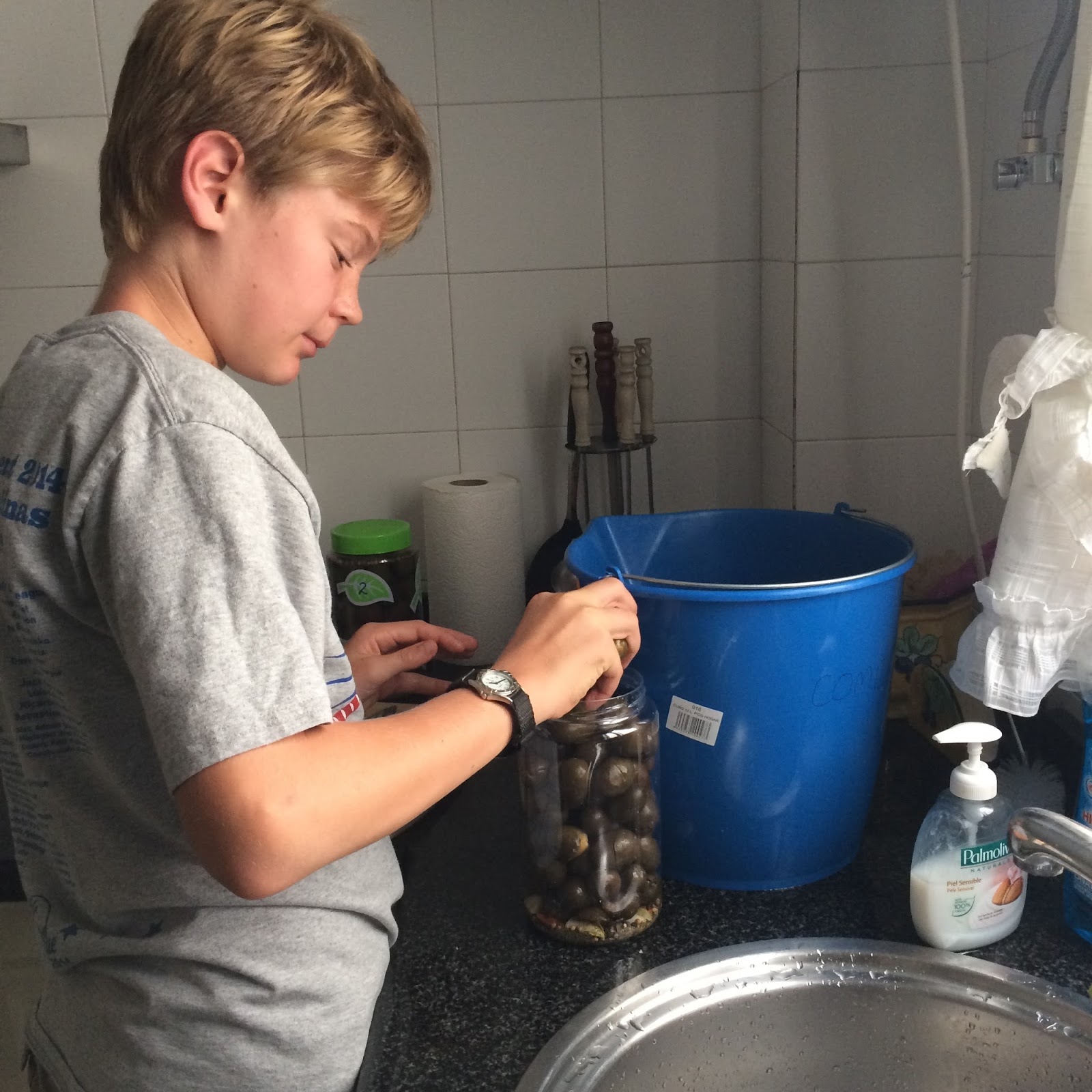
One of the things we are all really enjoying is cooking.  Elias has been really digging in, responsible for at least one dinner a week, and being very creative and successful with his cooking.  He's learning lots of new techniques, and applying them in great ways.   Tonight he and I worked together to make home-made pizzas, starting with fresh tomatoes for the sauce and hand-made crusts.  Awesome!

But our finest hour of cooking has been the olives he and I made, starting a month and a half ago.  I bought a big bag of olives, a wooden mallet, and a bucket.  And we got to work.  First we smashed each olive individually to crack open the skin.  

Then we soaked them in water in the bucket, changing to fresh water daily until most of the bitterness was gone.  Our sources said two weeks, but it took us more than three weeks to get to an edible stage.  Then we divided them into six batches, and made several different variations of how we handled the brine, vinegar, and spices.

Some were brined, and then later put in vinegar and spice.  Others straight into a combination of brine, vinegar, and spices.  Some then got packed in olive oil, others just got a sealing layer of oil on the top of the jars.  The spices ranges from very simple to very spicy!


Each version came out delicious and very, very different.  I'm just hoping we can eat through enough of these in the next month so that Ingrid lets us make more batches while it is still olive season!


Here are the recipes we used for the olives.
Pre-prep:  Wack each olive with a wooden hammer until it splits, to allow the bitter oleuropein to leach out.  Put all the olives in a plastic bucket filled with water.  Put a plate on top of olives to keep all submerged.  Change water daily for about 3 weeks, until the the olive taste mellows (I've read that this can be done in a week, but for us 2 wks seems close, and 3 weeks perfect).  Divide the olives into batches for different spices and treatments.  Mason jars work really well for this.

We invented 6 varieties based loosely on different recipes we saw on line.  
1. In Oil.  Cover olives with brine (1/4 c salt + 4 c water), and let soak for a week.  Rinse olives. Place in jar with olives 2 squashed garlic cloves, 1 bay leaf, 1 sprig rosemary, and cover with olive oil.
2. Simple. Place in jar with olives: 2 bay leafs and 2 tsp coriander seeds.  Cover with 1/4 c salt, 4 c water, 1/2 c vinegar.  Layer with olive oil to cover surface.
3. Spicy.  Place in jar with olives: 1 tsp black peppercorn, 2 tsp coriander seed, 2 tsp oregano, 6 cloves smashed garlic, 6 pico-de-gallo chilies, 4 bay leaves.  Cover with 1/4 c salt, 4 c water, 1/2 c vinegar.  Layer with olive oil to cover surface.
4. Lemony. Place in jar with olives: 2 cloves smashed garlic, peel of a lemon (dried first in the oven), 1 tsp oregano.   Cover with 1/4 c salt, 4 c water, 1/2 c vinegar.  Layer with olive oil to cover surface.
5. Plain.  Place in jar with olives: 2 tsp peppercorns.   Cover with 1/4 c salt, 4 c water, 1/2 c vinegar.  Layer with olive oil to cover surface.
6. Romero.  Place in jar with olives: 3 sprigs rosemary, 2 sprigs thyme.   Cover with 1/4 c salt, 4 c water, 1/2 c vinegar.  Layer with olive oil to cover surface.

All six of these recipes produced great olives we enjoy eating.  The Simple and Plain varieties are pretty straight-forward olive-tasting olives.   The In Oil variety is good, but not better that the others packed in brine with a little olive oil on top -- not really worth the extra oil.  The Romero variety is tasty, with that Mediterranean spice flavor in the olives, but still a strong olive flavor.  The two family favorites are Spicy and Lemony.  I like the Spicy best: the olive flavor is still strong but the mix of flavors and touch of hot (mild, but noticeable) from the chilies combine to be the kind of olives I'd go back to buy on a regular basis.  The Lemony are Eli's favorite, which a strong lemon-zest component that is very distinctive and tasty (but a little too dominant a zest flavor to be a strong favorite for me).  The Romero and Simple are great sides to otherwise flavorful foods.


Monday, October 12, 2015

La Alpujarra

It has been a good, busy couple of weeks.  Ingrid and I have integrated more into the labs of Montse Vilà and Pedro Jordano, joining in lab meetings, lab lunches, and getting to know people.  We've also been feeling good about work again, with good progress on paper fronts.  Writing the Annual Review feels like writing pre-qual exams, but with the expectations that we can sound authoritative, not just well informed.  Part of the challenge is figuring out the exact audience we are writing for, because it is both for plant pathologists, most of whom have little background in evolutionary ecology, and for evolutionary ecologists who are interested in diseases, but with less real pathology background.  So there is a lot of framing needed for each group that doesn't really overlap.  Still, as always, being forced to write helps me figure out what I know and don't know,  and points me toward what I need to clarify in my own head.  Such a perfect project for sabbatical.

Elias is well settled into school now, and has regular Friday outings with the gang of kids from his class.  He is also very busy with the conservatory, which just got busier because he was accepted into the "external" orchestra, which plays at various places around the city, and includes another 2h/wk of rehearsals.  He is very excited to be playing so much.

This was a long weekend for the Fiesta Nacional de España (odd that it coincides with Columbus Day), so we managed to find an airB&B and a rental car and headed to the mountains.  We went to the southern part of the Sierra Nevada, called La Alpujarra, and stayed in a lovely old town, originally settled by Berber from Morocco.  All whitewashed buildings made of slate and chestnut, with defensively labyrinthine pathways through the town. 

We spent a lot of time hiking the trails through abandoned farms (it is a decidedly vertical existence there, a bit of a challenge after the flatlands of Sevilla), but such a wonderful, green escape from the urban life.  It was also a chance to try out my new Lumix FZ1000, which was a birthday replacement for my aged Nikon.  Fun chance to see what I could do with it. 


On the drive up we marveled at the clouds draped across the tops of the mountains, and it turned out that we were in those clouds most of the weekend (sometimes with rain, sometimes not).  But it was wonderfully cool and fresh and wet.  

We hiked hard for hours on Sunday, learned some plants and fungi, took some pictures, ate local cheese and bread,  and made friends with a wandering gang of local residents along the trail.  They don't talk much, but are cute.

Getting chestnuts ready for roasting
Collecting chestnuts
There are countless ripe chestnut trees and a lot of walnuts and rose hips to munch on too.  We collected over 100 chestnuts in about 10 min, roasted and ate a bunch, and brought the rest home.  Had some other great food too -- Eli and Ingrid shared a jabalí stew (wild boar). 
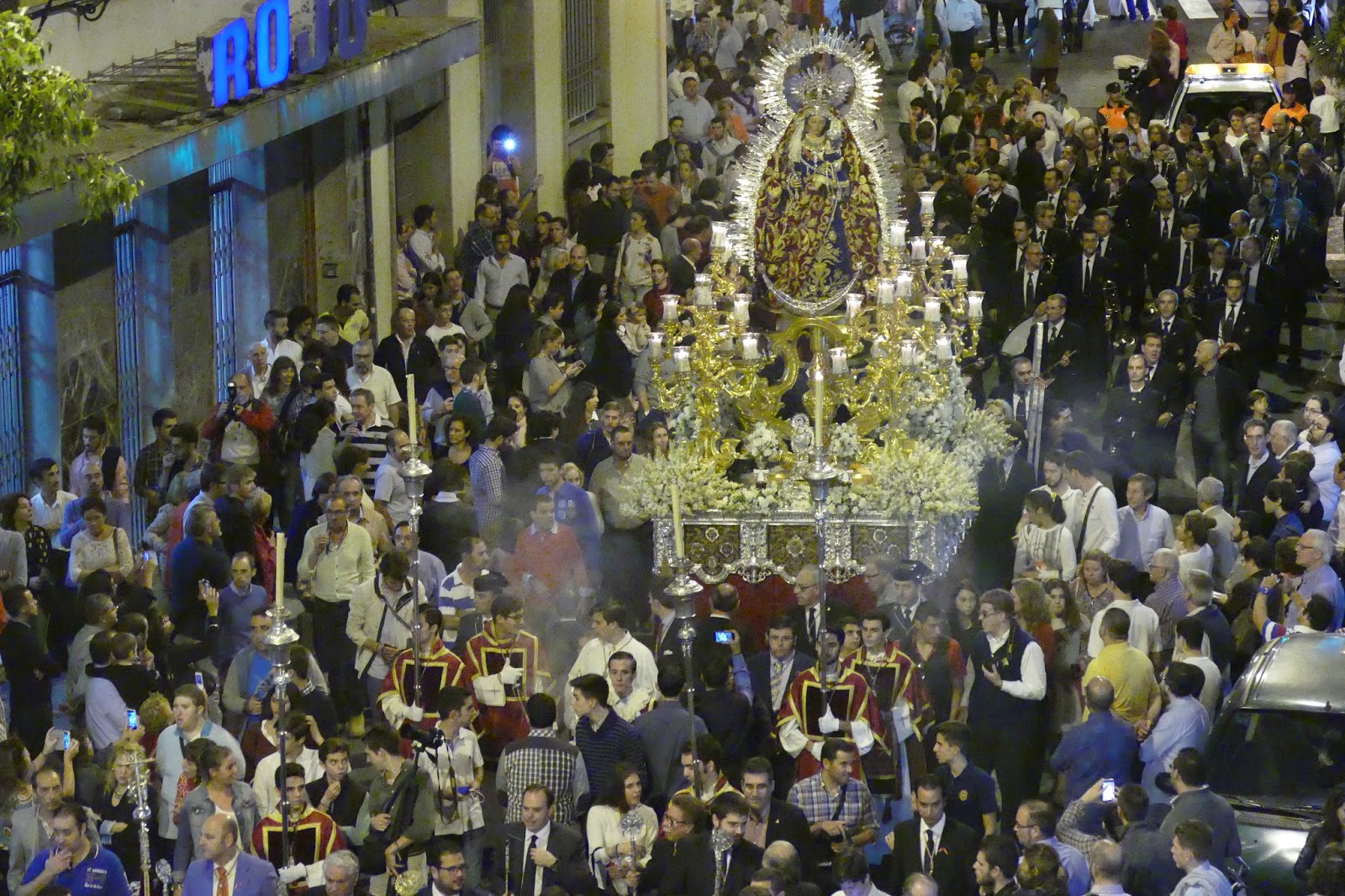
We stopped in the Arabic section of Granada on the way home for lunch, and then arrived back in Sevilla just in time for the festivities for the holiday.  Of course another virgin parade past our house, with marching bands, candles, and lots of incense.  We have prime seats from our balcony. 

Sunday, October 4, 2015

Pisos y Paredes


This was a project I've been working on slowly throughout our travels through Denmark, Istanbul, Athens, Ydra, and Sevilla.  I love the brick and stone work in walls (paredes), floors (pisos), streets, and sidewalks; some ancient, some new.  It was hard to narrow it down to just 24, but these are my favorites.  Can you guess where they are from?

Friday, October 2, 2015

Off to work we go

Ingrid and I have a wonderful commute to the EBD.  Ingrid even lets me carry her school bag.  I think she likes me.  ☺️


Monday, September 28, 2015

On to real life

Ingrid on her way to work
Now that Elias is in school and almost all home repairs and bureaucratic paper shuffling is finished (we still have a few weeks before we are residents, and then some bank business), we can get back to a regular work schedule.  Ingrid and I are both working on finishing up some separate projects (I just finished long-overdue fixes of my ferp.ucsc.edu and greggilbertlab web sites - should be live today or tomorrow!), but are now more seriously tackling writing up our chapter for Annual Review of Phytopathology, due in December.  It is an exciting time that feels a little like being a grad student again -- we are expected to read deeply in the literature, synthesize it, and say something reasonably intelligent.  I hope we are up to the task!

On top of the Torre de Oro, with La Giralda
in the background, where Columbus
is supposedly buried.

Fortunately, we still have the flexibility to plan our own schedules, including a visit to the Torre de Oro, where the riches coming back from the West Indies in the 16th and 17th centuries all passed.  The 16th century drawings of rows of dozens of ships in the port just down the block where we live are remarkable. 

Yesterday morning we took a 2-h bike / in-line skate trip through eastern Sevilla to the Nervión district, where one of two stores in the city sell essential Chinese food products, like tofu, black-bean sauce, and wasabi peas.  Sevilla has really done bike/skating lanes right!